
Serving Brighton, MI & Southeast Michigan Since 2000
When Should You Use Open-Cell Spray Foam Insulation?
The Short Answer: Attics, Walls, and Anywhere Moisture Isn't a Factor
Open-cell spray foam is the right choice for interior walls, attics, cathedral ceilings, and above-grade applications where moisture exposure is low and a complete air seal is the primary goal. It delivers the same airtight seal as closed-cell foam at a lower cost per square foot — making it the smart choice for large interior areas.
At Seal Tech Insulation, we help homeowners in Brighton, Howell, and Milford choose the right foam for every part of their home. The decision between open-cell and closed-cell isn't complicated once you understand where each one excels. For Michigan building code requirements, see the Michigan Bureau of Construction Codes and Energy Star's Seal & Insulate guidelines.
✅ Use Open-Cell Spray Foam For:
- Attic rafters & roof decks
- Interior 2x4 and 2x6 walls
- Cathedral ceilings
- Interior floor cavities
- Sound control between rooms
- Above-grade applications
❌ Do NOT Use Open-Cell For:
- Crawl spaces
- Rim joists
- Basement walls (below grade)
- Exterior foundation walls
- Areas with direct moisture exposure
- Applications needing R-13+ in 2x4 walls
Video Transcript & Summary
0:00 – The question: America's Home Experts host John Bujak asks Seal Tech owner Eric Stimach: "When should a homeowner choose open-cell spray foam over closed-cell?"
0:08 – Eric's answer: Eric explains that open-cell spray foam is ideal for attics, interior walls, and cathedral ceilings — anywhere you want a complete air seal without the higher cost of closed-cell. Open-cell expands dramatically to fill every cavity and gap, creating an airtight thermal envelope.
0:22 – The sound control bonus: Eric highlights that open-cell spray foam is significantly better than closed-cell for sound dampening. Its soft, spongy structure absorbs sound waves, making it an excellent choice for interior walls between rooms, home theaters, and bedrooms.
0:38 – Where NOT to use it: Eric is clear that open-cell is not the right choice for crawl spaces, rim joists, or any below-grade application. Those locations need the moisture-blocking properties of closed-cell spray foam. Using open-cell in a crawl space can allow moisture to accumulate inside the foam, leading to mold and structural issues.
0:52 – The Brighton, MI context: In Michigan's Climate Zone 5, open-cell spray foam in an attic typically needs to be installed at 5.5 to 6 inches to meet the R-20 code minimum for above-grade walls, or thicker for attic applications requiring R-49.
What Is Open-Cell Spray Foam and How Does It Work?
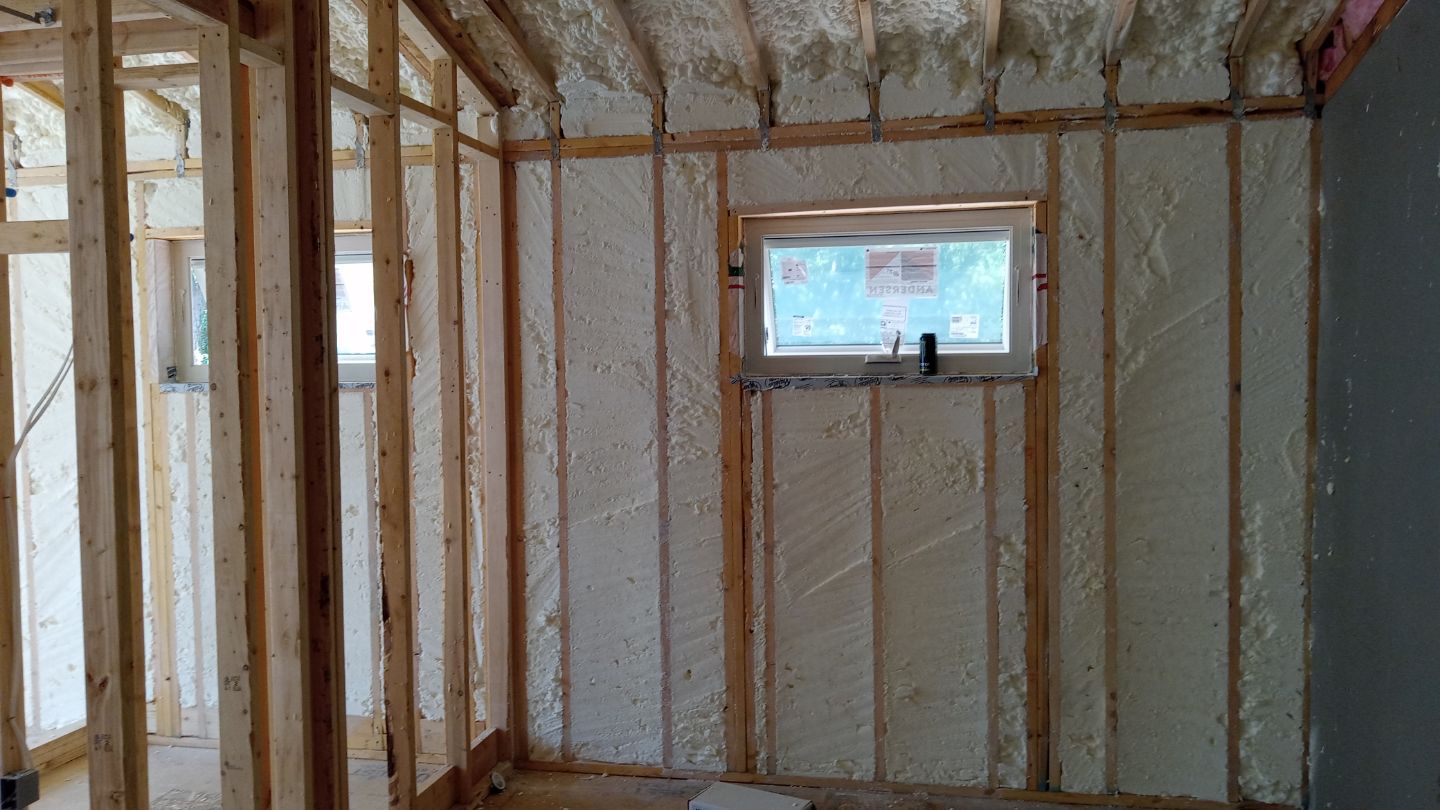
Open-cell spray foam is a two-component polyurethane foam that expands dramatically when sprayed — up to 100 times its liquid volume. Unlike closed-cell foam, the cells in open-cell foam are intentionally left "open," giving the cured foam a soft, spongy texture similar to a dense foam pillow.
This open structure has two important consequences: it makes the foam vapor-permeable (moisture can pass through it slowly), and it makes the foam an excellent sound absorber. Open-cell spray foam typically achieves R-3.5 to R-3.8 per inch, compared to R-6 to R-7 per inch for closed-cell.
Despite its lower R-value per inch, open-cell spray foam creates the same complete air seal as closed-cell — and air sealing is responsible for 40% of a home's heat loss. That's why open-cell spray foam in an attic or wall cavity dramatically outperforms fiberglass batts, even though fiberglass has a higher R-value per inch on paper.
Brighton, MI Code Note: Brighton is in IECC Climate Zone 5. Michigan's residential energy code requires R-49 for attics and R-20 for above-grade walls. To meet R-20 in a 2x6 wall with open-cell spray foam (R-3.7/inch), you need approximately 5.5 inches of foam — which fits perfectly in a standard 2x6 stud bay. For 2x4 walls, closed-cell is typically required to meet code.
Open-Cell vs. Closed-Cell: Which Is Right for Each Location?
| Location | Recommended Foam | Why |
|---|---|---|
| Attic rafters / roof deck | Open-cell ✅ | Large volume needed; low moisture; excellent air seal; cost-effective |
| Interior 2x6 walls | Open-cell ✅ | Fills cavity completely; meets R-20 code; adds sound control |
| Cathedral ceilings | Open-cell ✅ | Fills deep rafter bays; no ventilation gap needed; complete air seal |
| Interior 2x4 walls | Closed-cell preferred | Needs R-13+ in 3.5" cavity; open-cell only achieves R-13 at 3.5" |
| Rim joists | Closed-cell ✅ | Moisture exposure; needs vapor control; high R-value in thin application |
| Crawl space walls/floor | Closed-cell ✅ | Direct moisture exposure; open-cell will absorb water and grow mold |
| Basement walls (below grade) | Closed-cell ✅ | Ground moisture; vapor retarder required; closed-cell is Class II VR |
| Garage ceiling / floor above | Open-cell ✅ | Air seal + sound control; no moisture risk from above |
The Sound Control Advantage of Open-Cell Spray Foam
One of the most underrated benefits of open-cell spray foam is its superior sound dampening performance. The soft, spongy cell structure absorbs sound waves rather than reflecting them — making open-cell spray foam significantly better than closed-cell for noise reduction between rooms.
For Brighton homeowners building a home theater, a music room, a nursery, or simply wanting quieter bedrooms, open-cell spray foam in the interior walls delivers a noticeable difference. It's also commonly used in floor cavities between stories to reduce impact noise and airborne sound transmission.
Closed-cell spray foam, while excellent for exterior applications, is too rigid and dense to absorb sound effectively. For interior sound control, open-cell is always the better choice.
⚠️ Important: Never use open-cell spray foam in a crawl space, on a rim joist, or on any below-grade surface. Open-cell foam is vapor-permeable — it allows moisture to slowly pass through. In a crawl space or basement, this means moisture from the ground can accumulate inside the foam, leading to mold growth and wood rot. Always use closed-cell foam for these applications.
How Much Open-Cell Spray Foam Do You Need?
The amount of open-cell spray foam needed depends on the application and the R-value required by Michigan's energy code. Here are the most common thicknesses for Brighton-area homes:
| Application | Code Requirement (Zone 5) | Open-Cell Thickness Needed | Approx. R-Value |
|---|---|---|---|
| Attic (unvented) | R-49 | 13–14 inches | R-49 to R-52 |
| Above-grade walls (2x6) | R-20 | 5.5 inches (full cavity) | R-20 to R-21 |
| Cathedral ceiling | R-49 | 13–14 inches | R-49 to R-52 |
| Floor cavity (above garage) | R-30 | 8–9 inches | R-30 to R-33 |
| Interior walls (sound only) | No code req. | 3.5–5.5 inches | R-13 to R-20 |
Is Open-Cell Spray Foam Worth the Cost?
Open-cell spray foam typically costs $1.00 to $1.50 per board foot installed — roughly 30–50% less than closed-cell spray foam. For large applications like attics and cathedral ceilings, this cost difference is significant. A full attic insulation job that might cost $8,000–$10,000 with closed-cell can often be done with open-cell for $4,000–$6,000 — with the same complete air seal result.
The key is using the right foam in the right place. Open-cell in an attic is an excellent investment. Open-cell in a crawl space is a costly mistake. Seal Tech's free evaluation helps Brighton homeowners make the right choice for every part of their home before a single dollar is spent.
Seal Tech Serves Brighton & All of Southeast Michigan
Seal Tech Insulation installs open-cell and closed-cell spray foam insulation for homeowners in Brighton, Howell, Milford, and across Southeast Michigan. We serve:
Not Sure Which Foam Is Right?
Open-cell or closed-cell — the answer depends on where in your home you're insulating. Get a free evaluation from Seal Tech and we'll tell you exactly which foam goes where in your Brighton-area home.
Get Free Evaluation 📞 (866) 775-3626⚡ Quick Reference
Open-cell R-value: R-3.5 to R-3.8 per inch
Best for: Attics, interior walls, cathedral ceilings
Sound control: Excellent
Moisture resistance: Vapor-permeable (not for crawl spaces)
Cost vs closed-cell: 30–50% less per sq ft

📍 Serving Brighton & SE Michigan
We help homeowners in Brighton, Howell, Milford, and 19 more Southeast Michigan cities choose the right insulation for every part of their home.
Brighton Service Area →
As seen on America's Home Experts, Seal Tech Insulation is Southeast Michigan's trusted spray foam contractor — serving Brighton, Livingston County, and the greater Detroit metro area.
Ready to Insulate Your Brighton Home the Right Way?
Get a free, no-pressure evaluation — we'll tell you exactly which foam goes where and give you a straight quote.
Schedule Free Evaluation 📞 (866) 775-3626