
Serving Saline, MI & Southeast Michigan Since 2000
How Long Does Spray Foam Insulation Last?
The Short Answer: The Lifetime of Your Home
Spray foam insulation lasts 80 to 100+ years — effectively the lifetime of the structure it's installed in. Unlike fiberglass batts that compress, sag, and lose R-value within 15 to 20 years, spray foam bonds permanently to the framing and substrate. It does not settle, shift, or degrade under normal conditions.
At Seal Tech Insulation, we tell every homeowner in Saline, Ann Arbor, and Milan the same thing: spray foam is a one-time installation. Once it's in, it's in for good. That's one of the key reasons spray foam delivers a better long-term return on investment than any other insulation type. For more on Michigan insulation standards, see the Michigan EGLE Energy Office and Energy Star's Seal & Insulate program.
Video Transcript & Summary
0:00 – The question: America's Home Experts host John Bujak asks Seal Tech owner Eric Stimach: "How long does spray foam insulation actually last — do homeowners ever need to replace it?"
0:08 – Eric's answer: Eric explains that spray foam insulation is designed to last the lifetime of the home — 80 to 100 years or more. Unlike fiberglass, which compresses and loses R-value over time, spray foam bonds permanently to the structure and maintains its performance indefinitely.
0:20 – Open-cell vs. closed-cell longevity: Eric notes that both types are permanent, but closed-cell spray foam is especially durable due to its rigid, dense structure. Closed-cell is also a Class II vapor retarder, which protects the building envelope from moisture damage that can degrade other insulation types.
0:35 – The comparison to fiberglass: Eric points out that fiberglass batts in a typical Michigan home will start losing effectiveness within 15 to 20 years as they compress and absorb moisture. Spray foam never compresses, never absorbs moisture, and never needs to be topped off or replaced.
Why Does Spray Foam Last So Much Longer Than Fiberglass?
The durability gap between spray foam and traditional insulation comes down to how each material responds to the forces that degrade insulation over time: gravity, moisture, and temperature cycling.
Fiberglass batts are held in place by friction between studs. Over years of Michigan's freeze-thaw cycles, the batts compress under their own weight, shrink away from framing edges, and absorb moisture from air infiltration — all of which reduce their effective R-value. Cellulose blown-in insulation settles significantly in attics over time, sometimes losing 20–30% of its installed depth within a decade.
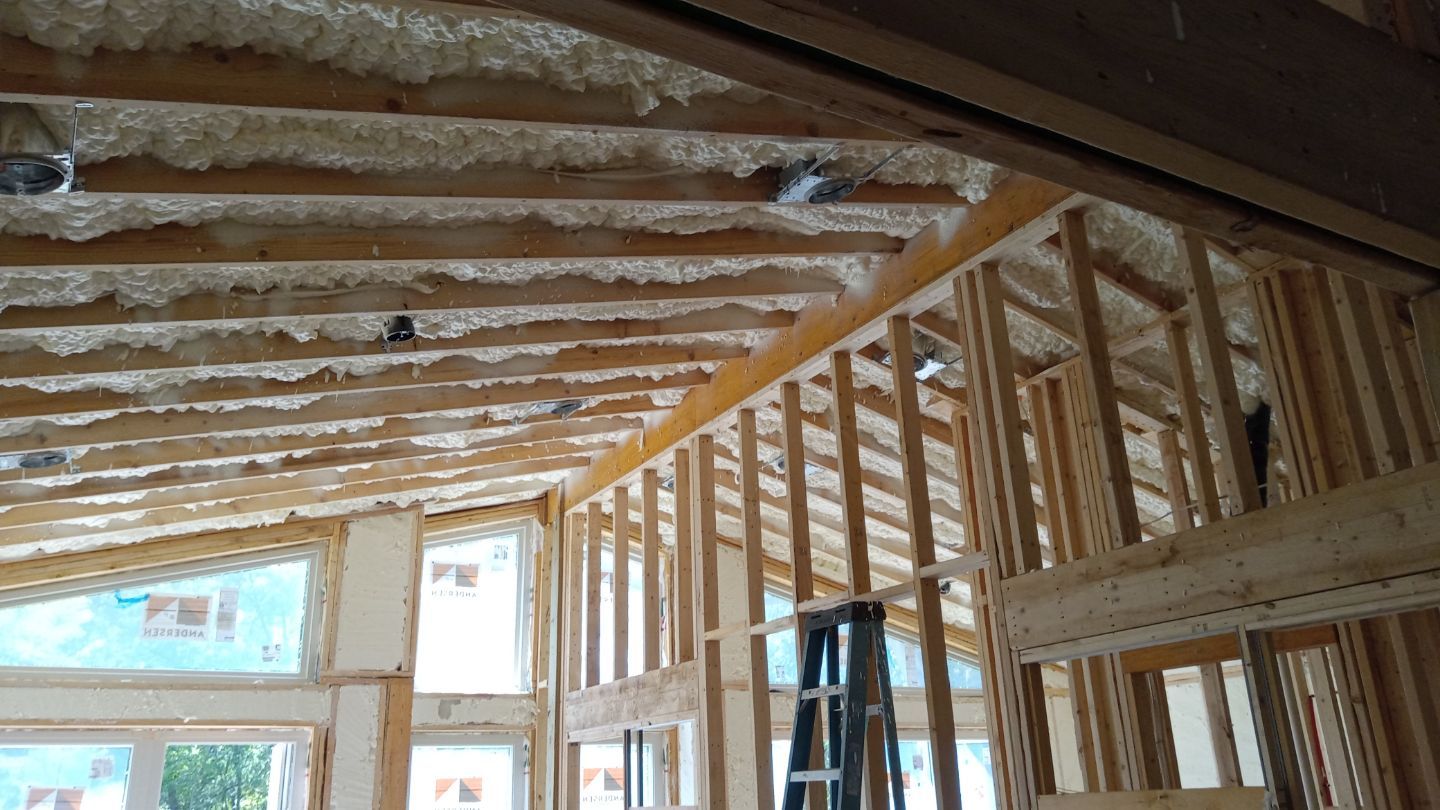
Spray foam insulation, by contrast, chemically bonds to every surface it contacts. It becomes part of the structure — not just something sitting inside it. Once cured, it does not move, compress, settle, or absorb moisture. The R-value you get on day one is the R-value you'll have in 50 years.
Saline, MI Climate Note: Saline sits in Washtenaw County in IECC Climate Zone 5, where freeze-thaw cycling is extreme. Homes in Saline see 100+ freeze-thaw cycles per year — conditions that accelerate the degradation of fiberglass and cellulose insulation. Spray foam's permanent bond and closed-cell vapor control make it especially well-suited for Saline's climate.
Does Spray Foam Insulation Ever Need to Be Replaced?
Under normal conditions, no. Spray foam insulation does not need to be replaced during the lifetime of a home. There are only a few scenarios where spray foam might need to be removed or repaired:
| Scenario | Does It Affect Spray Foam? | What Happens |
|---|---|---|
| Normal aging (80+ years) | No degradation | R-value and air seal remain intact |
| Moisture / flooding | Closed-cell: unaffected. Open-cell: may absorb water | Closed-cell dries out; open-cell may need inspection |
| Structural renovation / remodel | Must be mechanically removed if framing is altered | Removed and reinstalled in affected areas only |
| Pest damage | Closed-cell: highly resistant. Open-cell: some risk | Closed-cell's density deters most pest penetration |
| UV exposure | Degrades if left exposed long-term | Must be covered with drywall, paint, or thermal barrier |
Open-Cell vs. Closed-Cell: Which Lasts Longer?
Both open-cell and closed-cell spray foam insulation are designed to be permanent. However, closed-cell spray foam has a durability advantage in certain applications:
- Closed-cell is rigid and dense (2 lb/ft³), making it highly resistant to physical compression, moisture infiltration, and pest damage. It's the preferred choice for crawl spaces, rim joists, basement walls, and any area with potential moisture exposure.
- Open-cell is softer and more flexible (0.5 lb/ft³), making it ideal for interior walls and attics where moisture exposure is minimal. It's equally permanent in terms of R-value retention, but less suited for below-grade or high-moisture applications.
For Michigan homeowners in Saline and surrounding Washtenaw County, Seal Tech typically recommends closed-cell spray foam for crawl spaces, rim joists, and basement walls — and either type for attics and interior walls depending on the specific application.
How Does Spray Foam Compare to Other Insulation Types Over Time?
| Insulation Type | Typical Lifespan | R-Value Retention | Moisture Resistance | Air Sealing |
|---|---|---|---|---|
| Closed-Cell Spray Foam | 80–100+ years | Permanent — no loss | Excellent (Class II vapor retarder) | Complete air seal |
| Open-Cell Spray Foam | 80–100+ years | Permanent — no loss | Good (not a vapor retarder) | Complete air seal |
| Fiberglass Batts | 15–25 years | Degrades 20–40% over time | Poor — absorbs moisture | None — air passes through |
| Blown-In Cellulose | 20–30 years | Settles 20–30% in attics | Poor — absorbs moisture | Minimal |
| Rigid Foam Board | 25–50 years | Good — minimal loss | Good | Partial — gaps at seams |
What Is the Long-Term ROI of Spray Foam vs. Fiberglass?
When you factor in lifespan, the economics of spray foam insulation become even more compelling. A fiberglass batt installation in a Michigan home will likely need to be replaced or supplemented within 20 years — meaning you pay twice (or more) over the life of the home. Spray foam is installed once and never touched again.
Here's a simple comparison: A fiberglass attic insulation job might cost $2,000 and last 20 years before needing replacement. Over 60 years, you've paid $6,000 and still don't have an air seal. A spray foam attic installation might cost $3,500 — once — and deliver superior energy savings and air sealing for the next 80+ years. The math is not close.
Seal Tech Guarantee: Seal Tech Insulation stands behind every installation. Our spray foam work is backed by the manufacturer's material warranty and our own workmanship guarantee. If you ever have a question about your installation — years or decades later — we're here to answer it.
Seal Tech Serves Saline & All of Southeast Michigan
Seal Tech Insulation installs spray foam insulation that lasts the lifetime of your home — for homeowners in Saline, Ann Arbor, Milan, and across Southeast Michigan. We serve:
Get a Lifetime Insulation Quote
Spray foam is a one-time investment. Get a free, no-pressure evaluation from Seal Tech and find out exactly what it would cost to insulate your Saline-area home — permanently.
Get Free Evaluation 📞 (866) 775-3626⏳ Lifespan at a Glance
Spray foam insulation: 80–100+ years
Fiberglass batts: 15–25 years
Blown-in cellulose: 20–30 years
R-value loss over time: None (spray foam)
📍 Serving Saline & SE Michigan
We help homeowners in Saline, Ann Arbor, Milan, Chelsea, and 18 more Southeast Michigan cities insulate their homes for life.
Saline Service Area →
As seen on America's Home Experts, Seal Tech Insulation is Southeast Michigan's trusted spray foam insulation contractor — serving Saline, Washtenaw County, and the greater Detroit metro area.
Ready to Insulate Your Saline Home — For Life?
Get a free, no-pressure evaluation from Southeast Michigan's spray foam experts since 2000.
Schedule Free Evaluation 📞 (866) 775-3626