
Serving Ypsilanti, MI & Southeast Michigan Since 2000
Closed Cell Spray Foam Cost: Why It Costs More Than Open-Cell
The Short Answer: Closed Cell Spray Foam Cost Is Higher Because of the Blowing Agent
Closed cell spray foam cost is higher because it uses a gas-based blowing agent — a hydrofluorocarbon (HFC) or newer hydrofluoroolefin (HFO) — that creates a denser, more rigid foam with a higher R-value per inch. Open-cell spray foam uses water as its blowing agent, which is far less expensive and produces a softer, lower-density foam.
At Seal Tech Insulation, we help homeowners in Ypsilanti, Ann Arbor, and Saline understand exactly what they're paying for — and why the higher closed cell spray foam cost is justified in the right applications. For Michigan energy code requirements, see the Michigan Bureau of Construction Codes and Energy Star's Seal & Insulate guidelines.
Open-Cell Spray Foam
- Blowing agent: Water
- Density: ~0.5 lb/ft³ (soft)
- R-value: R-3.5 to R-3.8/inch
- Vapor permeable
- Best for: Attics, interior walls
Closed-Cell Spray Foam
- Blowing agent: HFC or HFO gas
- Density: ~2 lb/ft³ (rigid)
- R-value: R-6 to R-7/inch
- Class II vapor retarder
- Best for: Crawl spaces, rim joists
Video Summary
The core question: America's Home Experts host John Bujak asks Seal Tech owner Eric Stimach why closed-cell spray foam costs more than open-cell.
Eric's explanation — the blowing agent: The key difference is the blowing agent. Open-cell spray foam uses water, which is inexpensive and creates a soft, spongy foam. Closed-cell spray foam uses a gas-based blowing agent — historically HFCs, now transitioning to lower-GWP HFOs — that is significantly more expensive but creates a denser, higher R-value material.
Density and R-value: The gas blowing agent in closed-cell foam creates smaller, more uniform cells that pack together tightly. This is what gives closed-cell its rigid structure (2 lb/ft³ vs. 0.5 lb/ft³ for open-cell) and its higher R-value of R-6 to R-7 per inch — nearly double the R-3.5 of open-cell.
Modern formulas vs. older versions: Eric notes that modern closed-cell formulas use HFO blowing agents with a much lower global warming potential than the older HFC formulas used in the 1970s and 80s. Today's closed-cell is both higher-performing and more environmentally responsible than its predecessors.
When each foam is ideal for Michigan homes: Closed-cell is required for crawl spaces, rim joists, and basement walls in Michigan's Climate Zone 5. Open-cell is the better choice for attics and interior walls where moisture isn't a factor and cost efficiency matters.
What Exactly Is a Blowing Agent?
A blowing agent is the chemical that causes spray foam to expand when it's applied. When the two liquid components of spray foam mix at the spray gun, a chemical reaction generates heat — and the blowing agent vaporizes, creating millions of tiny gas bubbles that expand the foam to many times its liquid volume.
💧 Open-Cell: Water as Blowing Agent
Water reacts with one of the foam components (isocyanate) to produce CO₂ gas, which creates the bubbles. The cells remain "open" — connected to each other — giving the foam its soft, spongy texture. Water is cheap and abundant, which is a major reason open-cell foam costs less.
⚗️ Closed-Cell: Gas as Blowing Agent
Closed-cell foam uses a hydrofluorocarbon (HFC) or hydrofluoroolefin (HFO) gas as its blowing agent. These gases are significantly more expensive than water, but they create smaller, more uniform cells that seal shut — giving closed-cell its rigid structure, higher R-value, and vapor-blocking properties.
Ypsilanti, MI Context: Ypsilanti sits in Washtenaw County in IECC Climate Zone 5. Michigan's energy code requires R-15 continuous or R-19 cavity for crawl space walls — requirements that closed-cell spray foam meets efficiently in just 2.5 to 3 inches. Open-cell cannot meet these requirements in the same space and lacks the vapor control needed for below-grade applications in Michigan's climate.
What You're Actually Paying for With Closed Cell Spray Foam
The higher price of closed-cell spray foam isn't just about the blowing agent cost — it's about what that blowing agent delivers. Here's what you get with closed-cell that you don't get with open-cell:
| Feature | Open-Cell | Closed-Cell |
|---|---|---|
| R-value per inch | R-3.5 to R-3.8 | R-6 to R-7 |
| Density | ~0.5 lb/ft³ (soft) | ~2 lb/ft³ (rigid) |
| Vapor permeability | Vapor-permeable | Class II vapor retarder |
| Moisture resistance | Absorbs moisture | Resists moisture infiltration |
| Structural strength | None | Adds racking strength to walls |
| Sound dampening | Excellent | Moderate |
| Cost per board foot | $1.00–$1.50 | $1.50–$3.00 |
| Best applications | Attics, interior walls | Crawl spaces, rim joists, basements |
Modern Closed-Cell vs. Older 1970s Formulas
Eric makes an important point in the video: modern closed-cell spray foam is very different from the formulas used in the 1970s and 1980s. Early closed-cell foams used CFC (chlorofluorocarbon) blowing agents — the same chemicals linked to ozone depletion. Those were phased out under the Montreal Protocol.
The industry then shifted to HFC (hydrofluorocarbon) blowing agents, which don't harm the ozone layer but have a high global warming potential (GWP). Today, the industry is actively transitioning to HFO (hydrofluoroolefin) blowing agents, which have a GWP of less than 1 — more than 1,000 times lower than HFCs.
The bottom line: today's closed-cell spray foam is not only higher-performing than older formulas — it's also significantly more environmentally responsible. Seal Tech uses modern, low-GWP closed-cell formulations on every job.
Is the Closed Cell Spray Foam Cost Worth It?
In the right application, absolutely yes. The question isn't whether closed-cell is "better" than open-cell — it's whether the application requires what closed-cell uniquely provides.
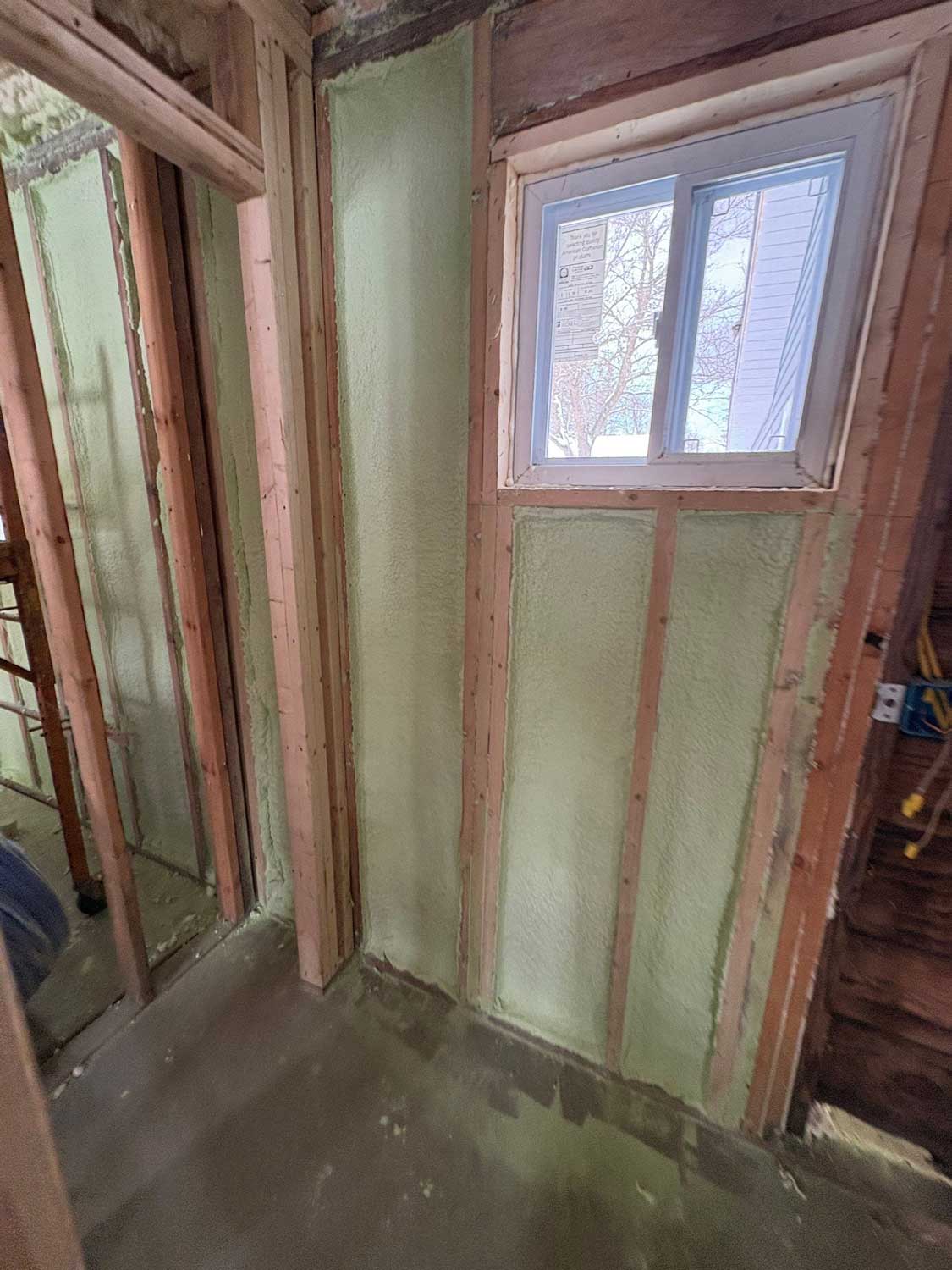
For a crawl space in an Ypsilanti home, the closed cell spray foam cost is a necessary investment. The ground constantly emits moisture vapor, and open-cell foam would absorb that moisture, leading to mold growth and wood rot within a few years. The extra cost of closed-cell in a crawl space is not optional — it's required.
For an attic, open-cell spray foam delivers the same complete air seal as closed-cell at roughly half the cost. In that application, paying the higher closed cell spray foam cost is often unnecessary — unless you need the higher R-value per inch to meet code in a shallow rafter bay.
Seal Tech's free evaluation helps Ypsilanti homeowners understand exactly which foam is needed where — so you never overpay for closed-cell where open-cell would work, and never cut corners with open-cell where closed-cell is required.
Seal Tech Serves Ypsilanti & All of Southeast Michigan
Seal Tech Insulation installs both open-cell and closed-cell spray foam for homeowners in Ypsilanti, Ann Arbor, Saline, and across Southeast Michigan. We serve:
Get an Honest Quote — Open or Closed Cell
Not sure which foam your home needs? Seal Tech will assess every area of your Ypsilanti-area home and give you a straight recommendation — no upselling, no pressure.
Get Free Evaluation 📞 (866) 775-3626⚡ Quick Cost Reference
Open-cell: $1.00–$1.50 / board ft
Closed-cell: $1.50–$3.00 / board ft
Why the difference: Gas blowing agent (HFO/HFC) vs. water
Closed-cell R-value: R-6 to R-7/inch
Open-cell R-value: R-3.5 to R-3.8/inch


📍 Serving Ypsilanti & SE Michigan
We help homeowners in Ypsilanti, Ann Arbor, Saline, and 19 more Southeast Michigan cities get the right foam for the right application.
Ypsilanti Service Area →
As seen on America's Home Experts, Seal Tech Insulation is Southeast Michigan's trusted spray foam contractor — serving Ypsilanti, Washtenaw County, and the greater Detroit metro area.
Ready to Get the Right Foam for Your Ypsilanti Home?
Get a free, no-pressure evaluation — we'll tell you exactly which foam goes where and give you a straight quote.
Schedule Free Evaluation 📞 (866) 775-3626