
Serving Ann Arbor, MI & Southeast Michigan Since 2000
What Is R-Value? (And Why Your Home Is Cold)
What Is R-Value? The Plain-English Answer
R-value is a measure of how well an insulation material resists heat flow. The "R" stands for thermal resistance. The higher the R-value, the better the insulation material slows the movement of heat through your walls, attic, floors, and crawl space — and the warmer and more comfortable your Michigan home stays all winter long.
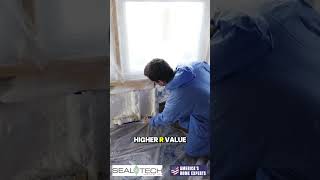
Jack Stimach from Seal Tech Insulation explains it this way: think of R-value like the thickness of a winter coat. A thin windbreaker has a low R-value — it slows some heat loss, but not much. A heavy-duty parka has a high R-value — it keeps you warm even in Michigan's coldest weather. Your home's insulation works exactly the same way. Understanding R-value is the first step to knowing whether your home in Ann Arbor, Saline, or Plymouth is actually protected. Learn more from the U.S. Department of Energy's insulation guide and the City of Ann Arbor Office of Sustainability.
Video Transcript & Summary
0:00 - The question: Jack Stimach from Seal Tech Insulation introduces the concept of R-value and why it matters for Michigan homeowners who are struggling with cold drafts and high energy bills.
0:10 - What R-value measures: Jack explains that R-value is a material's resistance to heat flow. Every insulation material — fiberglass, cellulose, open-cell foam, closed-cell foam — has an R-value rating per inch of thickness.
0:25 - How thickness changes your protection: Jack demonstrates how adding more inches of insulation increases your R-value. At 1 inch of closed-cell spray foam you get R-6 to R-7. At 2 inches you get R-12 to R-14. At 3 inches you get R-18 to R-21. More R-value means a warmer, more comfortable Michigan home.
0:45 - Why your home might be cold: Jack explains that if your home feels cold even with the heat running, your insulation likely has a low R-value — or gaps and air leaks that bypass the insulation entirely. Spray foam insulation solves both problems at once by sealing and insulating simultaneously.
R-Value Requirements for Michigan Homes
Michigan sits in IECC Climate Zone 5, which has some of the highest R-value requirements in the country. If your home doesn't meet these minimums, you're losing heat — and money — every single day of winter.
| Location in Home | Michigan Minimum R-Value | Seal Tech Recommendation |
|---|---|---|
| Attic / Ceiling | R-49 | R-49 to R-60 |
| Exterior Walls | R-15 continuous | R-21 with closed-cell foam |
| Crawl Space Walls | R-10 | R-20+ with closed-cell foam |
| Basement Walls | R-10 | R-20+ with closed-cell foam |
| Rim Joists | R-10 | R-20+ with closed-cell foam |
| Floor Over Unconditioned Space | R-30 | R-30 to R-38 |
R-Value by Insulation Type: How Do They Compare?
Not all insulation materials deliver the same R-value per inch. This is why spray foam insulation is so powerful — it delivers the highest R-value per inch of any common insulation material, which means you can hit Michigan's required R-values even in tight wall cavities and shallow rim joists.
Source: U.S. Department of Energy — Insulation Materials R-Values
Why R-Value Alone Doesn't Tell the Whole Story
Here's what most insulation companies won't tell you: R-value only measures heat resistance — it does not measure air leakage. A home can have R-49 fiberglass in the attic and still feel cold and drafty if there are air gaps around recessed lights, plumbing penetrations, and attic hatches. Air infiltration bypasses the insulation entirely.
This is why spray foam insulation outperforms fiberglass even when the R-values look similar on paper. Spray foam insulation seals every gap and crack as it expands, creating a continuous air barrier that fiberglass physically cannot provide. When Seal Tech installs spray foam insulation in your Ann Arbor or Southeast Michigan home, you get both the R-value and the air seal — in a single application.
Michigan Climate Note: Southeast Michigan sits in IECC Climate Zone 5. Homes here need higher R-values than most of the country. If your home was built before 2010, there's a strong chance your attic, crawl space, or rim joists are under-insulated by today's standards — and that's why your energy bills are high.
What R-Value Do I Need for My Michigan Home?
The answer depends on where in your home you're insulating. Attics need the highest R-value (R-49 minimum in Michigan). Walls need R-15 to R-21. Crawl spaces and rim joists need R-10 to R-20. Seal Tech's free home evaluation will tell you exactly what R-value you currently have — and what you need to reach peak comfort and efficiency.
Seal Tech Serves All of Southeast Michigan
Seal Tech Insulation installs spray foam insulation with the highest R-value per inch available for homeowners and businesses across Southeast Michigan. We serve:
Find Out Your Home's R-Value
Not sure if your home meets Michigan's R-value requirements? Our experts will assess your attic, walls, and crawl space — free of charge.
Get Free Evaluation 📞 (866) 775-3626

📍 Serving Ann Arbor & SE Michigan
We install open-cell and closed-cell spray foam insulation in Ann Arbor, Saline, South Lyon, and 20+ more cities across Southeast Michigan.
Ann Arbor Service Area →
As seen on America's Home Experts, Seal Tech Insulation is a trusted provider of spray foam insulation, attic insulation, and crawl space solutions throughout Detroit and Southeast Michigan.
Ready to Find Out What R-Value Your Home Actually Has?
Get a free, no-pressure home evaluation from Southeast Michigan's spray foam experts since 2000.
Schedule Free Evaluation 📞 (866) 775-3626